Digital Futures ~ Martin Hamilton


Showing posts with label my.Lboro. Show all posts
Here's a rather fuzzy video of my session on Google Apps from the JISC Innovating E-Learning Conference 2012.  In this talk I outline the aspects of Google Apps that Learning Technologists and those involved in pedagogical application of Google's tools may not be aware of, such as the Google Apps Marketplace for Education and Google's RESTful APIs for building on top of the products - and why this will all become hugely relevant with the proposed curriculum changes to encourage our children to learn to program.


You can also view the slides themselves via Slideshare, or embedded below:


Or, since these are just a collection of web pages, why not open those links in your favourite browser?  I have collected them together in a handy companion document, embedded below.  Click through to edit or comment on this, should you wish to add your own voice.


And finally...  I will try never to say "whole bunch of stuff" again in a public talk!  Nearly used up my lifetime allocation in that one session :-)


Here's a quick teaser video for my talk at the JISC Innovating E-Learning Conference, on November 19th 2012.  Sign up now, so you don't miss out!


We recently launched a new website for Loughborough students that pulls together information from key sources around the University and also from the Students Union. It's called "my.Lboro", and (surprise!) if you are at Loughborough you can get to it by visiting http://my.lboro.ac.uk.In this post I'll talk a little bit about what the site provides, cover the feedback that we have received on it, and the way that we have gathered feedback using a shared Google Docs document. I think this has been quite an innovative way to build an IT system that "grows up in public", and it would be interesting to hear from other institutions as to whether they have tried this approach.First, though, here's a video teaser of what the my.Lboro site has to offer... 


Here's a capture of my talk yesterday on practical cloud computing for the Loughborough Students Union Computer Society (LSUCS):


(see how quickly I recovered from the Beachball of Doom there :-)


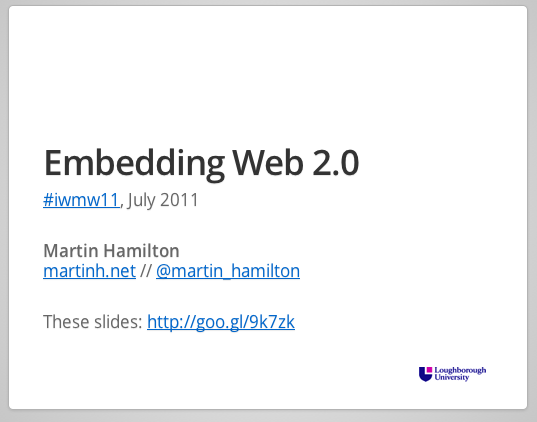
I thought it would be interesting and fun to make my plenary session at IWMW11 a bit more interactive than simply me standing up and waffling in front of a bunch of slides. Here's a few words about what I did and how I did it, plus some feedback from the interactive parts of the talk, and a few observations about this year's IWMW event.

In this post I'll pick up on and amplify a few of the themes from the talk that Parmjit Dhugga and I did about the JISC Strategic ICT Toolkit at the recent JISC 2011 conference in Liverpool.  But first, a cheezy video that I made to introduce the toolkit... :-)


The Strategic ICT Toolkit is a new resource from JISC, developed by the University of Nottingham Graduate School in partnership with the Leadership Foundation for Higher Education. It follows on from a report by Duke and Jordan that identified significant variation on institutional approaches to IT strategy. Fundamentally the toolkit is an aide to reflective thinking about IT strategy, with a wealth of background material and case studies, and a self-analysis component that you can use to "rate your IT strategy".

This blog post describes some work that Garry Booth and I have been doing at Loughborough to prototype a Mobile Web site as part of our student portal project. It expands on the themes I raised in my talk at the recent Developing for the Mobile Web workshop hosted by UKOLN and the ILRT. My slides can be viewed below via slideshare.net...


I’ve blogged in the past about our project to create a student portal at Loughborough this Autumn. This post is intended to provide a quick update and also to explore some of the architectural issues that have arisen.

In a previous post I introduced the concept that a portal did not necessarily equate to “a portal system”, i.e. a dedicated piece of software. This is a theme that I want to pick up on here. If we had been putting a portal in a few years ago, then we would almost certainly have surveyed the market and looked at packages like uPortal, Sakai and Liferay. Why not simply put one of these systems in now?

Here's why...

One of my current projects is to pull together a student portal for Loughborough.  For a variety of reasons we missed the boat and failed to develop such a system back in the Noughties, but I think this is something we can turn to our advantage by learning from other people's experiences.

My view is that our portal (see left for portal concept poster from Ben Spencer in our Web design team) will be mostly about giving people a handy preview of information that's relevant to them, and linking through to systems and services that we already run - rather than imposing a whole new IT system on everyone.  One convenient side-effect of this not being a direct replacement for an existing system is that we will be able to introduce it as and when it's ready, thereby avoiding the traditional mad rush to get everything ready for the start of the academic year.

The initial system will be very tightly scoped, and is mostly about us identifying a sensible underlying architecture that we can continue to build on.  On launch day we are aiming for something along like this: