Digital Futures ~ Martin Hamilton


Showing posts with label googleapps. Show all posts

Earlier this summer our technology forum surveyed heads of IT in further and higher education to find out more about the state of cloud adoption. It was quite a mixed picture - whilst 45% of respondees were using cloud services for business applications such as payroll processing, 31% had no plans to move to cloud for these applications. It was clear from the survey that many people were discouraged from using public cloud providers like Amazon Web Services and Microsoft Azure because of a perception that costs would be difficult to anticipate and contain. 61% of respondents said that financial issues were a major concern for them. We thought it was timely to do some further work in this area, and have just released a report exploring the future and potential of cloud computing for our community.


If you could change anything in the education system, what would your 'moonshot' be? This was the question asked of 40 educators, edtech innovators and entrepreneurs from around the world who were invited to Google's Moonshot for Education Summit in Amsterdam last week, which I was delighted to be able to attend representing Jisc.

For those unfamiliar with the term 'moonshot', when President Kennedy announced the Apollo programme in 1961 space exploration was just beginning, but by 1969 the first people walked on the surface of the moon - a seemingly unthinkable achievement less than a decade before. Examples of modern day moonshots include driverless cars, personal genomics and personalised medicine, and new materials like graphene. Some of the most innovative of these new technologies are being developed by Google, such as Project Loon, which uses high altitude balloons to provide internet service to rural and hard to reach areas (we've just heard that Google will be connecting the whole of Sri Lanka to the internet using Loon). The video below explains Google's own approach to moonshot thinking:


 As Google chief executive Larry Page stated in a 2013 interview with Wired: "It's not easy coming up with moonshots. Where would I go to school to learn what kind of technological programs I should work on? You'd probably need a pretty broad technical education and some knowledge about organisation and entrepreneurship. There's no degree for that." To which we could add one word: yet.

Moonshots in education

So what do we mean by a moonshot in education? In an era when all of human knowledge is freely available online, and the nature of work is fundamentally changing, we have to ask ourselves how the education system needs to evolve to reflect our new realities. This is particularly important when we look at the tech skills required for the digital economy.

A recent study by Deloitte and the University of Oxford found that "35% of existing jobs in the UK are at high risk from automation over the next two decades, with jobs paying less than £30,000 a year nearly five times more likely to be replaced by automation than jobs paying over £100,000." Meanwhile, the European Commission projects there will be almost a million unfilled tech vacancies across Europe by 2020.

Which brings us to the Moonshot Summit. Our hosts for the summit were Esther Wojcicki and the EdTechTeam. Esther is an award-winning teacher from Palo Alto High School in California, vice chair of Creative Commons, and consultant to Google's Education team. Esther has embraced technology in education as a way of liberating and empowering teachers and pupils, as described in her book Moonshots in Education. Esther's approach to moonshot thinking in education is nicely summed up in this video interview, Educating for the Unforeseen Jobs of the New Economy:


What if...?

In a 2013 interview on the TED blog, Jisc Digital Festival keynote speaker Sugata Mitra says: "It's quite fashionable to say the education system is broken. It's not. It's wonderfully constructed - it's just that we don't need it anymore. It's outdated." This was a commonly held view amongst the teachers who attended the Moonshot Summit, and we began the event by exploring the delegates' big ideas for transformative change in education.

Here are just a few of the 'what ifs' to come out of those discussions:
  • What will the iPad generation need and expect from college or university?
  • What if children were grouped by ability rather than their date of birth?
  • What if learning was as addictive as Candy Crush or Flappy Bird?
  • What if we eliminated the constant cycle of assessment?
  • What if my (other?) teacher was a robot, or an algorithm?
And the big one...
  • What if there were no schools?
It was telling for me that educators attending the Moonshot Summit largely felt that whilst a quantum leap was required in education, this was not principally about technology - in many ways the technology we already have is 'good enough', and we are not fully exploiting it. However, there were some examples cited of new technologies that could have a genuinely transformative effect.

While we might not see the anthropomorphic robots of 1950s science fiction gliding around the corridors of our schools and colleges any time soon, apps like MathBingo and DuoLingo's free language learning platform - which now has over 100 million users worldwide, with examples of how it can be used for gamification of learning - show how technology can be used to augment and enhance contact hours in the classroom and lecture theatre.

Four key trends emerged from our initial discussions:
  • Resources and teacher support
  • Innovative assessment
  • Equity and agency
  • Engagement and agency
The first two themes in particular struck a chord (and correlate well with the recommendations of the UK's Education Technology Action Group). Delegates overwhelmingly felt that teachers needed support and encouragement to transform their approach from 'sage on the stage' to more of a mentoring and coaching role.

They also felt that education as a whole should move away from a culture of high stakes summative assessment and 'teaching to the test' to a more incremental approach that recognises and credits students' mastery of their study topics. As things stand, learners are often branded as failures simply because they learn at a different pace to their peers or have different aptitudes.

Ideation

Our facilitators from EdTechTeam then formed groups of like-minded individuals to ideate towards projects around these themes that the participants could take away to work after the Moonshot Summit. We used a 'design sprint' approach for this that would be very familiar to anyone who has participated in Jisc's co-design initiative for new R&D projects.

You can read a detailed description of the Moonshot Summit design sprint in Yoni Dayan's post for LinkedIn Pulse, but I will pull out the main ideas here:
  • Gamifying the curriculum - real problems are generated by institutions or companies, then transformed into playful learning milestones that once attained grant relevant rewards.
  • Dissolving the wall between schools and community by including young people and outsiders such as artists and companies in curriculum design.
  • Creating a platform where students could develop their own learning content and share it, perhaps like a junior edX.
  • Crowdsourcing potential problems and solutions in conjunction with teachers and schools.
  • A new holistic approach to education and assessment, based on knowledge co-construction by peers working together.
  • Creating a global learning community for teachers, blending aspects of the likes of LinkedIn, and the Khan Academy.
  • Extending Google's 20% time concept into the classroom, in particular with curriculum co-creation including students, teachers and the community.
You can also view each of our teams' pitches in the Moonshot Summit 'Space Walk' slide deck.

What's next?

The Moonshot Summit is now over, but as participants we are keen to follow up these discussions and explore which of these ideas can usefully be taken forward. While they were largely conceived of with school age learners and school teachers in mind, there are clear parallels with further and higher education and skills - which I am interested in exploring from a Jisc perspective. You can follow #MoonshotEDU on social media to participate in the global dialogue.

I'd also love to hear your own moonshot ideas - do you agree that education needs a reboot, and do the ideas I've outlined above resonate with you? Will your college or university be ready for the iPad generation? To discuss further, please do get in touch with me or leave a comment below.


Has your institution used Google Apps, Android, Chromebooks, Glass or other Google technologies in an innovative way? We would love to hear from you, and would like to take the opportunity to showcase your projects at GEUG14, the Google Apps for Education European User Group conference.


Following the success of GEUG12 in Portsmouth and GUUG11 in Loughborough, the University of York has been working with Google to organise the next Google Apps for Education European User Group meeting (GEUG14). This event will be held on 23rd - 24th June 2014 at the University of York, UK, and is open to both users and prospective users of Google Apps for Education. If you are interested in attending the event, please answer the questions below to help us deliver a programme that will be of interest/use to you.

It's starting to feel like we are really living in the 21st century at last: Elon Musk's Hyperloop, vat-grown artificial meat, 3D printing hitting the high streets (and we're now 3D printing human organs) and hedge funds are beaming neutrinos through the Earth's core in a bid to accelerate high frequency trading. The Star Trek tricorder will shortly be a reality too. But, this is just one side of the story. Quoting Ian Livingstone, Co-Founder of Games Workshop and CEO of Eidos: "Something is wrong when you have one million young people unemployed and 100,000 jobs vacant in IT".


I was invited to speak at this year's BETT as part of the new Higher Education strand of the event.  My talk was all about the "perfect storm" of changes that are happening in the sector right now, and how we can respond to them.  Why the sleepy cat?  Well, when things get stressful, sometimes you just need to take a Kitten Break to calm yourself down...  [Thanks to Ray Kent from De Montfort University for introducing me to the kitten break]

As we near the year's end, time for a quick look back at the highlights of 2012.  My Twitter word cloud for 2012 above (via wordle.net) points at the likes of HPC Midlands, our work on open data and GEUG12 (the Google Apps user group meeting I helped to organize), but misses out one very important thing - winning a Times Higher Award!  

This post is all about Linux.  How did that plucky little penguin come to be the software behind Google, Amazon and Facebook, nearly all of the top 500 supercomputers, and over 500m Android phones and tablets?  Read on...

Here's a rather fuzzy video of my session on Google Apps from the JISC Innovating E-Learning Conference 2012.  In this talk I outline the aspects of Google Apps that Learning Technologists and those involved in pedagogical application of Google's tools may not be aware of, such as the Google Apps Marketplace for Education and Google's RESTful APIs for building on top of the products - and why this will all become hugely relevant with the proposed curriculum changes to encourage our children to learn to program.


You can also view the slides themselves via Slideshare, or embedded below:


Or, since these are just a collection of web pages, why not open those links in your favourite browser?  I have collected them together in a handy companion document, embedded below.  Click through to edit or comment on this, should you wish to add your own voice.


And finally...  I will try never to say "whole bunch of stuff" again in a public talk!  Nearly used up my lifetime allocation in that one session :-)


Here's a quick teaser video for my talk at the JISC Innovating E-Learning Conference, on November 19th 2012.  Sign up now, so you don't miss out!


If you're at a European University or College using Google Apps, you've probably noticed that we are holding a Google Apps for Education European User Group event (geug12) on June 15th in Portsmouth.  As part  of the sign-up process for this we thought it would be useful to ask people what they would like to see covered in the event, and have been signing up speakers based on this "feedforward".

In this post I'll quickly whiz through what we've had back from people to date. At this point we have 51 delegates signed up from 32 organizations in Denmark, France, Ireland, Malta, Poland and the UK. We can fit a few more people in though, so do sign up if you are an existing Google Apps customer and this interests you.

So, first off it transpires that most of our delegates are already running Google Apps as a production service, as shown in the graph below:
Incidentally the graphs, tables etc in this post are generated for us automatically by the Google Forms system that we use for sign-ups, so it's just a matter of clicking Form then Show Summary of Responses in the corresponding Google Docs spreadsheet to view them. 

We were very pleased at last year's guug11 event to have a good mixture of delegates from diverse backgrounds including senior management, E-Learning experts, systems integration gurus and project managers.  It looks as though this pattern is set to be repeated at geug12:
As part of the sign-up for the event, we asked people about their preferences for topics to be covered.  We put these questions in a matrix using a Likert scale type approach, as shown below:


It was quite striking that migration to Google Apps was still a hot topic even though we had a lot of people who were already running production services - as shown in the graphic below.  This is probably a reflection of the fact that some institutions are still in the throes of migrating email, calendar etc.  We also know anecdotally that there are institutions where individual Apps are being enabled over a period of time so as to not to overwhelm people with new stuff all at once.
I was also struck by the level of interest in using Google Apps as a platform to build on, and we have a couple of talks lined up in this area with Julian Lintell-Smith and Sharif Salah from the University of Portsmouth, and Ed Crewe from the ILRT at the University of Bristol.  Clearly the message has sunk in that Google Apps is much more than just the default set of user facing services.
It was probably a given that institutions would be interested in comparing notes with their peers, but I was surprised to see the extent to which it was felt to be an essential part of the event - as shown below by the overwhelming response to this question.  Accordingly we have arranged a long lunch break and a couple of refreshment breaks, and created the opportunity for people to duck out of the formal sessions by having a parallel session structure.  We hope you will find the networking opportunities useful!
In response to this feedback we have also arranged several talks on innovative uses of Google Apps at institutions, and I'm particularly pleased to have a number of European speakers including Barry Foley from the University of Cork, Maciej Broniarz from the University of Warsaw and Benjamin Six from the ESSEC Business School in France.

We talked about building on Google Apps as a platform above, but it was clear from the responses that people still felt that it was worth spending time on the ostensibly mundane issues around integration with institutional systems such as the VLE and Single Sign-On - as shown in the results below.
 

Of course, this last year the big news has been Google+, the new kid on the block, and we were sure that people would be interested in hearing from practitioners about their own use of Google+ - this was borne out  by the questionnaire responses, as shown below.  I'm particularly delighted that Alan Cann from the University of Leicester and Sarah Horrigan from the University of Sheffield will be presenting on this.  Alan's session will be a true test of the technology, as he will be coming in remotely via a Google+ Hangout.
The talks on mashups by Tony Hirst and Martin Hawksey at last year's guug11 event were extremely well received, and I'm indebted to both Martin and Tony for making themselves available for a followup session at geug12. This will cover some of the most intriguing but less well known Google technology such as Google Fusion Tables and Google Refine.  Again it was clear from the delegate responses that this was an area of great interest.
In such a rapidly changing field, we knew that people would be keen to keep up to date on the latest developments with Google products and services, and this was evident from the questionnaire responses:


However, established products such as Android, Chrome OS and the Google Search Appliance were only rated as "desirable" by delegates (as per below), implying that people wanted to hear more about the very latest developments - and upcoming attractions. With this in mind we have arranged for a roadmap briefing from Google which will be the morning keynote session. Whilst we are hoping to live stream the majority of geug12 sessions via the Google+ Hangouts on Air system, I'm afraid that this session will not be broadcast due to its sensitive nature. [We reserve the right to turn WiFi off and jam phone signals too... ;-]
As an IT manager I find that events like guug11 and geug12 are very helpful for sharing experiences and helping to inform strategy development.  It was interesting to see (as per below) that in spite of the varied backgrounds of our delegates, across the board they felt that the long term issues around Google Apps, legal considerations, and engagement with Google were key topics.

In response to this we have arranged a session with Des Burley from SGH Martineau on cloud legal issues, e.g. implications that institutions need to consider when activating Google Apps Marketplace applications to extend their domain's services. We have also scheduled a panel session to discuss embedding Google Apps in the institution, which Brian Kelly from UKOLN has very kindly volunteered to chair. And the geug12 event will close with an open house session where delegates will be able to quiz Google directly.  Attendees at the guug11 event will remember that we were handing out T-shirts for questions, and I hope to do something similar at geug12!
We had good results at last year's guug11 event from the Open Mic session, which anyone could sign up to for a short "lightning talk", and it was clear from delegate responses that this would be a useful exercise to repeat for geug12:

If you would like to give a lightning talk at the Open Mic session, please visit the signup sheet and add your details.

Finally, just to remind people to visit the geug12 website for more information about the event. You can also follow +GEUG12 on Google+ for updates on the event and to get in touch about anything.

See you in Portsmouth on June 15th!


We recently launched a new website for Loughborough students that pulls together information from key sources around the University and also from the Students Union. It's called "my.Lboro", and (surprise!) if you are at Loughborough you can get to it by visiting http://my.lboro.ac.uk.In this post I'll talk a little bit about what the site provides, cover the feedback that we have received on it, and the way that we have gathered feedback using a shared Google Docs document. I think this has been quite an innovative way to build an IT system that "grows up in public", and it would be interesting to hear from other institutions as to whether they have tried this approach.First, though, here's a video teaser of what the my.Lboro site has to offer... 


Google Scholar is well known as a free search engine for academic papers and related documents. Less well known is Google Scholar’s “Citations” feature. In return for a few minutes of your time, Google Scholar Citations will automatically track your publications, calculate your H-index and i10-index, and create a public profile for you.


Here is some documentation that I recently prepared on Google Scholar for Loughborough University staff, which may be of more general interest.


Does your institution encourage academics to use services like Google Scholar, academia.edu and Mendeley to maximise their impact? Leave a comment and let me know!


This is a companion post to my talk with Google’s William Florance at the UCISA Using Social Media to Communicate workshop. We recorded the session, and you can watch it on YouTube via the embedded video below.


Here's a capture of my talk yesterday on practical cloud computing for the Loughborough Students Union Computer Society (LSUCS):


(see how quickly I recovered from the Beachball of Doom there :-)

In the last couple of weeks I have lectured this year's intake of Computer Science undergrad and postgrad students at Loughborough on Cloud Computing - the challenges it poses and the opportunities it creates. If you're interested, please see below for my slides. This blog post looks at some of the issues I raised in a bit more detail, and in a way which I hope will be interesting to both attendees of those lectures and readers from elsewhere on the net. Please do leave a comment and let me know what you think.


In this post I'll pull together the key themes that emerged in our "Cloud Learning with Google Apps" workshop at the ALT-C 2011 conference.

I was pleased that we had some 70 attendees express an interest in this session, making it one of the most popular parallel sessions at this year's ALT-C. Unfortunately we only had seats for 50 people, so my apologies to those attendees who had to stand, sit on the floor etc!


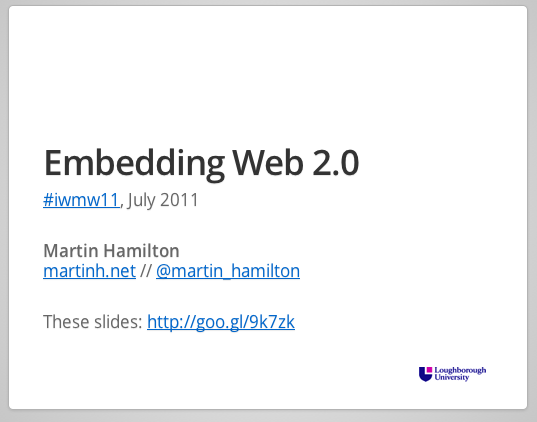
I thought it would be interesting and fun to make my plenary session at IWMW11 a bit more interactive than simply me standing up and waffling in front of a bunch of slides. Here's a few words about what I did and how I did it, plus some feedback from the interactive parts of the talk, and a few observations about this year's IWMW event.

I'm delighted to be able to report that IT Services at Loughborough University has been shortlisted for the 2011 Times Higher Leadership and Management Awards "Outstanding ICT Initiative" category. This is in recognition of our collaboration with Google to deliver a state of the art communication and collaboration suite for Loughborough students using Google Apps.  We'll know on June 16th whether we are the chosen ones :-)

I'd like to take this opportunity to thank current and former colleagues for all their hard work on Google Apps at Loughborough - in particular Chris Beggs, Garry Booth, Mike Cardwell, Nikki Doyle, Graeme Fowler, Kathryn Latham, Hina Mistry, Vishal Nathu, Lee Preston, Lynne Render and Ricardo Twumasi.

For the curious, I've appended a copy of our submission to the Times Higher Awards...  [Much of the text may be familiar if you have already read our Google at Loughborough Case Study!]


This is a follow-up to my talk at the UCISA 2011 management conference about the Google Apps experience at Loughborough University. For a quick overview of our project to implement Google Apps, please see the “Loughborough Goes Google” Case Study.

In this post I’ll look at using a tool called the Value Stream Map (see Rother and Shook's excellent book, "Learning to See") to help you analyze where and how much your existing business processes add value. I've chosen a scenario that illustrates the benefits of the move to Google quite nicely: